

Your Sales Room is your Candidate’s first real experience with your Brand that demonstrates you have a proven system. If your diligence process is reactive, documents forwarded and buried in email, followups that take a day, or worst of all nothing between calls, you’re not demonstrating that your brand has a proven system.
A well-built Franchise Sales Room gives your Candidate a first taste of your proven system that can support their process. Whether its short (60 days) or long (120 days), the experience is a big decision and involves their spouse or partner, franchise attorney, business partners, SBA lenders, and even peers and colleagues.
The candidate's experience across that span is mostly invisible to you — and what they can see, find, and re-read between conversations does most of the shaping.
A Sales Room can set their expectations across every step, give them a path forward, support their research, and build trust. Done poorly, it's a digital filing cabinet they never look at.
What is a great frandev Sales Room? Here’s the model that makes each stage land and how to evaluate your own setup against a Good / Better / Best setup.
At a glance: the 8 sections of a great Sales Room:
- Welcome / How to use this room
- Process overview (end-to-end roadmap)
- Stage-by-stage sections
- Candidate-specific documents
- Tasks and action items (with context)
- Testimonials and proof (threaded throughout)
- Downloadables
- Closing / What happens after “Yes”
What a Sales Room Is Actually For
A FranDev Sales Room is a guided, stage-based deal room that keeps candidates oriented through the high-stakes process of choosing your brand. It has four jobs.
A good Sales Room sets expectations, supports self-education, reinforces trust and momentum, and houses candidate-specific documents — all in one place the candidate keeps returning to.
Sets expectations across every stage. The Candidate always knows where they’re at in the process which also tell’s them what’s next and why. It builds trust in your brand by making promises and meeting every one when they see and understand how you set them up for success with the process.
Helps candidates self-educate without getting lost. Your Candidates research your brand and franchising lots of ways and on their own time. Sales room content is available when you’re not: at 11pm when they’re working on a business plan and trying to for a picture of what life as an owner looks like. Instead of hoping Reddit or ChatGPT will be actually helpful, you can support them with your Sales Room.
Reinforces trust and momentum over a long cycle. A Sales Room is the home base those that can keep the Candidate oriented between calls when they’re talking to their spouse or a Saturday morning at breakfast with a trusted friend. It gives them something credible to share with a spouse, advisor, or business partner.
Houses candidate-specific documents. Territory definitions, the FDD, custom financial packets, worksheets, and recap notes all need a home. A good Sales Room delivers the specifics for Candidates so they don’t have rely on their own notes or remember what you said on the call last week.
Lead with these four jobs with your Sales Room. If a piece doesn't serve at least one of them, it hasn't earned the space.
The 8 Sections of a Great Sales Room
1. Welcome / How to Use This Room
Orient the candidate and reduce friction. A short welcome video (under 90 seconds), an overview of what's inside, and a clear "do this first" instruction. Within thirty seconds, the candidate should know what kind of room they're in and what they're supposed to do next. You also need some “hype” content that reinforces your brand message here. Show them why people love your brand.
2. Process Overview (End-to-End Roadmap)
Given them on overview of whole journey so the candidate always knows where they are. Demonstrate your diligence process. Tell them how long each stage takes and a high level explanation of the objective.
3. Stage-by-Stage Sections
Include one section for each stage of your process. This is the next level of detail down from the Process Overview. What is stage called? What are the major activities? Provide materials and assets (workbooks, recommended lenders, manuals, etc.). What major questions are answered and outcomes are achieved?
Example: Don’t just tell them you have a Territory Validation call. Tell them “When our Territory Stage is complete you’ll know whether the market you’re interested in is a good fit for our brand and specific definition of the territory you’ll be buying.”
4. Candidate-Specific Documents
A centralized home for documents that belong to this Candidate in one place in the sales room. Their Territory definition, their FDD when appropriate, custom financial or validation packets, notes and recaps tied to specific milestones. This makes it easy for them to find and share everything throughout the process.
5. Tasks and Action Items (with Context)
Explicit next steps, paired with the why. A "Why this matters" explantion with each task, links to supporting resources, etc. You tell them on calls you want them to have a Franchise Attorney review the FDD and the Franchise Agreement. That’s great, but include in the Sales Room task additional context.
6. Testimonials and Proof — Threaded Between Stages
Threading additional “hype” and interest content throughout helps support their journey through diligence, reinforce the stage the candidate is currently in if possible. Customer testimonials, Franchisee testimonials, "a day in the life" clips, compiled "why I chose [brand]" snippets, additional videos from your Directors, Executives, Business Coaches, etc. These help remind the Candidate of the why and connect with your brand.
7. Downloadables / Asset Library
A single home for evergreen resources the candidate references independently: PDFs and one-pagers, comparison checklists, market data sheets, etc. An emerging best practice worth considering: an AI Diligence Packet. Your Candidates are using AI to evaluate your brand and inform their decision so give them a curated content packet they can download and feed to ChatGPT or Claude.
8. Closing / What Happens After Yes
Confirm expectations and reduce last-mile hesitation. Signing expectations and the commitment window, Discovery Day follow-up, a preview of the onboarding experience. The Candidate see that signing the FA isn’t last step in the process, but that it is the first step in their journey to being an Owner.
When you extend an offer to the Candidate, put the signing link here and move it to the top of the Sales Room.
The 3-Layer Model Inside Every Stage
This is the model that separates a Sales Room that has stage sections from a Sales Room where stage section actually do work for your when you’re not on a call with the Candidate. Inside each stage section, structure the content in three layers.
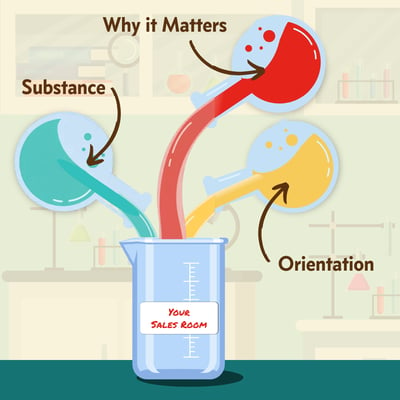
Orientation and what's about to happen. What this stage is, what decisions get made here, what the typical timeline looks like, what questions get answered, what is the outcome. A few sentences, written so a candidate can scan and orient quickly. This is where you’re making the promises you use to build trust.
Why it matters with the emotional and story context. How this stage contributes to the process and is part of your Candidate's plan. The common worries and the reassurance against them. Directly address common concerns or hesitations.
Substance using actual assets. The meat of what happens in the stage. For downloadables, linking to the central resource section is better, but you can include them here too. Video walkthroughs of what the stage entails or screenshares explaining the materials. Everything you’ll use use and show the Candidate during the stage.
A stage that runs only Substance is a document dump. A stage with Orientation and Why but no Substance is an empty pep talk. Figure out how you can hit all three layers in each stage.
Why Tasks Always Carry the "Why"
A checklist without context is busywork. A checklist with reasons is coaching.
"Have a franchise attorney review the FDD" is a chore. Add "Franchise attorneys with knowledge and experience in franchising can help you fully understand each item in the FDD and can give you independent advice and help you formulate the questions you have for us about the document." and you're communicating confidence, transparency and alignment with your Candidate's goals.
Every task in your Sales Room should answer three implicit questions: what is the task, why does it matter to me, and what should I look for. The first one is table stakes. The other two are what make the candidate feel guided, not railroaded or processed.
The Maturity Ladder: Good, Better, Best
If you're starting from zero, you don't need to build all of this on day one. Use the ladder to find where you are and what's next.
Good. Welcome section, process overview, basic stage pages, and a few core assets. The candidate can find their bearings and access the essentials. This is the floor that proves you're taking the room seriously.
Better. Stage pages run the full Orientation / Why / Substance model. There are multiple tasks in each stage. Tasks include the why. You have multiple testimonials and they thread through the room. The room starts feeling like a guided experience and not a file dump.
Best. Candidate-specific documents get added live as the candidate progresses. Proof and story show up throughout. The asset library supports the candidate's own advisors: attorney, CPA, spouse, friends who participate in or influence the decision. At this level, the Sales Room earns its own line item in what a candidate remembers about you.
The leap from Good to Better is mostly about the discipline of applying the same model consistently across every stage when you create the template. The leap from Better to Best is mostly about ownership: the Rep making sure the room stays current and engaging the Candidate in sales room at the start of every call, not just sending the link and forgetting about it.
Where to Start
Pull up your current Sales Room and walk it against this article. Pick one move this week:
- If you're not at Good yet: build the welcome section and the process overview. Those two unlock everything else.
- If you're at Good: apply the three-layer model to the where you lose the most candidates.
- If you're at Better: pick one Candidate currently in process and figure out what it would take to level up the candidate-specific section to Best for them.
Great Sales Rooms come together one disciplined layer at a time.